The Problem
Running arbitrary workloads on heterogeneous edge devices is harder than it looks. The edge is full of devices with different architectures, operating systems, and resource constraints. You want to ship code to a fleet of devices and have it run correctly on all of them — without pre-installing runtimes, without SSH access, and without a reliable network connection.
WebAssembly solves the portability problem. A WASM binary compiled once runs anywhere that has a WASM runtime. But that only solves half the problem. You still need a way to dispatch tasks, deliver binaries, and get results back — reliably, over a bandwidth-constrained connection that may drop at any time.
How It Works
Propeller has two main components that communicate over MQTT:
Manager (Go) — the control plane. Accepts task submissions via a REST API, stores task state in PostgreSQL (or SQLite for lighter deployments), and dispatches tasks to proplets over MQTT. Handles task lifecycle: pending → scheduled → running → completed/failed.
Proplet (Rust) — the execution agent. Runs on edge devices. Subscribes to MQTT
topics for its channel, receives StartRequest messages, fetches the WASM binary,
executes it in a sandboxed wasmtime instance, and publishes results back to the manager.
Manager (Go)
    │  REST API  │  MQTT pub
    │            ↓
    │     RabbitMQ broker
    │            ↓
    └──── Proplet (Rust) ──── wasmtime ──── WASM binary
                ↑
         result publish
MQTT was chosen over HTTP for the manager-proplet transport because it handles unreliable connections gracefully. QoS levels give you at-least-once delivery, the broker buffers messages when a device is offline, and the pub/sub model means you can fan out a task to multiple proplets with zero extra code.
WASM Binary Delivery
The most interesting engineering challenge was binary delivery. WASM binaries can be tens of megabytes. MQTT has a default message size limit of ~128MB but in practice brokers and clients struggle with messages over a few megabytes.
We implemented three delivery strategies, in order of complexity:
Inline base64 — for tiny binaries in development. The binary is base64-encoded
and sent directly in the StartRequest payload. Simple, but doesn't scale.
OCI registry — for production. The manager publishes the image reference, the proplet pulls the WASM binary from an OCI-compatible registry using the chunked MQTT protocol. The binary is split into ~512KB chunks, each published as a separate MQTT message, and the proplet reassembles them in order. This decouples binary size from message size.
HTTP URL — the newest delivery path. For cases where you're already serving
WASM binaries from a plain HTTP server, the proplet can fetch directly via reqwest
with a streaming 100MB size limit. No MQTT chunking overhead, no OCI registry needed.
async fn fetch_wasm_from_http(client: &HttpClient, url: &str) -> Result<Vec<u8>> {
    let response = client.get(url).send().await?;
    // fast-fail on content-length before downloading
    if let Some(len) = response.content_length() {
        if len as usize > WASM_FETCH_MAX_BYTES {
            return Err(anyhow!("response exceeds size limit"));
        }
    }
    // streaming read with running total check
    let mut binary = Vec::new();
    let mut stream = response.bytes_stream();
    while let Some(chunk) = stream.next().await {
        binary.extend_from_slice(&chunk?);
        if binary.len() > WASM_FETCH_MAX_BYTES {
            return Err(anyhow!("response exceeds size limit"));
        }
    }
    Ok(binary)
}
Embedded Proplet — Wasm on Microcontrollers
The most constrained environment Propeller targets is the ESP32-S3 — a dual-core Xtensa microcontroller with 512KB SRAM and no OS. To run WebAssembly on it, we use the WebAssembly Micro Runtime (WAMR) integrated with the Zephyr RTOS, with MQTT as the task transport layer.
I built and maintain the embedded proplet — a C implementation that runs on the ESP32-S3 and joins the same Propeller network as any Rust proplet:
- WiFi + MQTT client — handles credential provisioning, reconnect logic, and QoS-1 subscriptions for task delivery
- WASM handler — invokes WAMR to instantiate and execute Wasm modules with configurable memory limits and execution sandboxing
- Task monitor — collects metrics (heap usage, CPU cycles) and publishes heartbeat messages back to the manager
// Task dispatch on the embedded proplet
static void handle_start_request(const cJSON *payload) {
    const char *wasm_b64 = cJSON_GetStringValue(cJSON_GetObjectItem(payload, "wasm"));
    size_t wasm_len = 0;
    uint8_t *wasm_buf = base64_decode(wasm_b64, &wasm_len);
    wasm_handler_run(wasm_buf, wasm_len);
    free(wasm_buf);
}
The Zephyr kernel config required careful tuning — WAMR's JIT is unavailable on Xtensa, so we use the interpreter mode. The key result from benchmarking on a single-core configuration (512KB SRAM, no PSRAM):
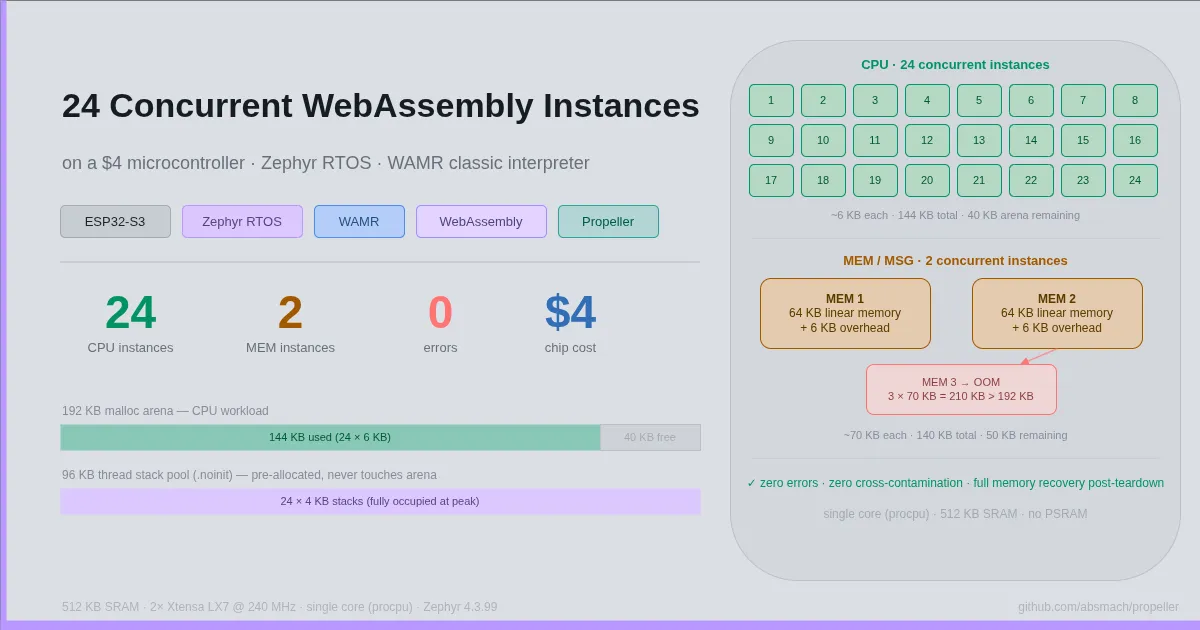
24 concurrent CPU-bound Wasm instances running simultaneously on a single $4 chip, with 40KB of arena remaining and zero errors. Each instance gets an isolated 4KB stack and ~6KB of linear memory — the module is parsed once and instantiated N times, so the parse cost is paid exactly once regardless of instance count. MEM-type workloads (64KB linear memory each) cap at 2 concurrent instances before hitting OOM — the benchmark maps the limits precisely.
This validates Propeller's core claim: a heterogeneous fleet ranging from cloud VMs to $4 microcontrollers can be orchestrated through the same MQTT-based dispatch layer.
The Hard Parts
MQTT reconnect drops subscriptions. When the manager sends a large MQTT message
(a 9MB WASM binary dispatched inline will do it), the broker drops the connection.
On reconnect, the manager re-publishes the message but its subscriptions — including
the heartbeat topic for proplet liveness — are not automatically re-established.
The proplet appears dead to the manager until a restart. The fix is to re-subscribe
after every reconnect. This is a well-known MQTT footgun that the spec handles via
cleanSession: false, but not all client libraries make this obvious.
wasmtime WASI-HTTP proxy. Running a WASM component that implements the
wasi:http/proxy interface requires specific wasmtime configuration. The proplet
supports both an external runtime (calling wasmtime run as a subprocess) and
an internal runtime (wasmtime embedded as a Rust library). Only the internal runtime
can configure the HTTP proxy listener properly. The PROPLET_EXTERNAL_WASM_RUNTIME
environment variable must be empty for WASI-HTTP workloads — a non-obvious constraint
that burned several hours of debugging.
Database migrations across two storage backends. Propeller supports both
PostgreSQL and SQLite. Every schema change needs a migration for both. We use
numbered migration IDs (1_create_tables, 2_add_workflow_job_columns, etc.) with
ALTER TABLE ... ADD COLUMN IF NOT EXISTS so migrations are idempotent. The PostgreSQL
and SQLite migration runners use different libraries but the same numbered ID scheme,
which makes it easy to keep them in sync.
What I'd Do Differently
Observability from day one. The current system is hard to debug in production. Task state is queryable via the REST API, but there's no distributed tracing and the MQTT message flow is invisible without attaching a broker-level monitor. Adding OpenTelemetry spans to the MQTT publish/subscribe path from the start would have saved significant debugging time.
Abstract the delivery mechanism earlier. The WASM delivery code in the proplet
started as an if/else over file vs image_url. Adding wasm_http_url as a third
path made the branching logic more complex than it needed to be. A proper
WasmSource enum with a fetch() -> Vec<u8> interface would have made each
delivery strategy independently testable from the start.
Use a proper service mesh for the broker. Running RabbitMQ in Docker works but the keep-alive timeout configuration is fragile. A managed MQTT broker (HiveMQ Cloud, EMQX) would remove an entire class of connection stability issues that are outside the application's control.